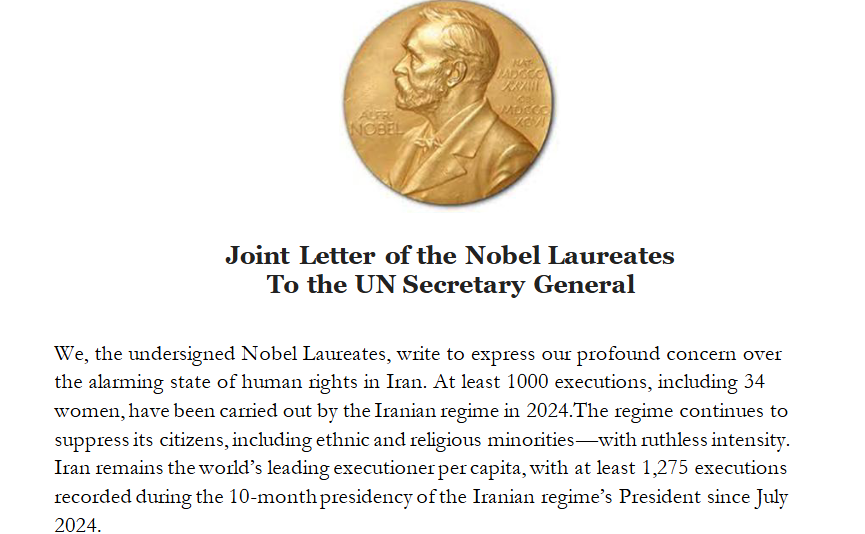
In a rare and powerful display of international academic and moral solidarity, over 100 Nobel Laureates have issued an urgent appeal to United Nations Secretary-General António Guterres, calling for immediate global attention to the deepening human rights crisis in Iran.
Their open letter—signed in July 2025—raises alarm over mass executions, ongoing state repression, and systemic denial of fundamental freedoms, particularly affecting vulnerable and marginalized populations.
Executions at Alarming Scale
The Nobel signatories condemned Iran’s continued use of the death penalty, describing it as a tool of intimidation and political control. In 2024 alone, at least 1,000 people were executed, including 34 women, placing Iran among the world’s highest executioners per capita.
The letter emphasizes that those targeted include not only alleged criminals, but also ethnic and religious minorities, young people, and ordinary citizens accused of vague or politically motivated offenses.
Such widespread use of capital punishment, particularly without fair trial guarantees, violates international human rights norms and contributes to a broader climate of fear.
A Population Silenced by Repression
The Laureates expressed deep concern over what they described as an “alarming state of human rights” in Iran. The country has seen repeated crackdowns on freedom of expression, assembly, and academic freedom. These actions are in clear violation of the International Covenant on Civil and Political Rights (ICCPR) and the Convention on the Rights of the Child (CRC), to which Iran is a party.
Citizens, including students, teachers, artists, and journalists, have been detained, tortured, and prosecuted for peaceful activities or simply for speaking out against injustice. The Laureates highlight that this repression is not isolated, but systemic and enduring.
Calls for a Rights-Based Future
Rather than endorsing specific political movements or ideologies, the letter articulates a vision for a future in Iran grounded in human dignity, universal suffrage, freedom of religion, gender equality, and peaceful coexistence.
The Nobel Laureates emphasized their support for the universal principles of democracy and human rights, and called for an Iran in which sovereignty belongs to the people, and basic freedoms are guaranteed for all, regardless of gender, religion, or ethnicity.
Appeal to the United Nations and Global Leaders
The Laureates called on the United Nations and international bodies to:
- Hold Iran accountable for violations of its international human rights obligations.
- Condemn the use of executions, especially against juveniles and marginalized groups.
- Support the Iranian people’s right to free expression, peaceful protest, and democratic participation.
- Ensure protection for at-risk populations, including religious minorities, women, and detained activists.
Their message was clear: silence in the face of these atrocities only enables further abuse.
An Unprecedented Academic Consensus
The letter has been signed by 103 Nobel Prize recipients across disciplines—including Peace, Literature, Physics, Chemistry, Medicine, and Economics—from over 30 countries. Signatories include:
- Professor Daron Acemoglu (Economics, 2024)
- Professor Svetlana Alexievich (Literature, 2015)
- Professor Peter Agre (Chemistry, 2003)
- Professor Harvey J. Alter (Medicine, 2020)
- Leymah Roberta Gbowee (Peace, 2011)
- Professor Alain Aspect (Physics, 2022)
- Dmitry Muratov (Peace, 2021)
- Jody Williams (Peace, 1997)
- Professor Wole Soyinka (Literature, 1986)
- Mr. Kailash Satyarthi (Peace, 2014)
This unprecedented appeal from some of the world’s most respected scientific and humanitarian voices demonstrates broad international concern for the human rights situation in Iran.
A Moral Obligation to Act
This is not a call for political intervention, but for humanitarian action. The message from the Laureates is clear: basic human rights are not negotiable, and the international community must not remain indifferent while lives are lost and freedoms denied.
The signatories remind us that real peace and stability—both in Iran and the wider region—cannot be achieved without justice, accountability, and respect for human dignity.
Their appeal should serve as a wake-up call to global leaders and institutions: the people of Iran deserve to live free from fear, with their rights respected, and their voices heard.
As a human rights organization, we echo this call and urge:
- The United Nations Human Rights Council to convene an emergency session on the situation in Iran.
- The UN Office of the High Commissioner for Human Rights (OHCHR) to expand monitoring and documentation of human rights violations in Iran.
- Governments and civil society worldwide to support the Iranian people’s struggle for freedom from repression, and to demand an immediate moratorium on executions.
Every individual has the right to live in dignity, to speak freely, and to dream without fear. The international community must stand united in defending these rights—not for political gain, but for the sake of humanity itself.