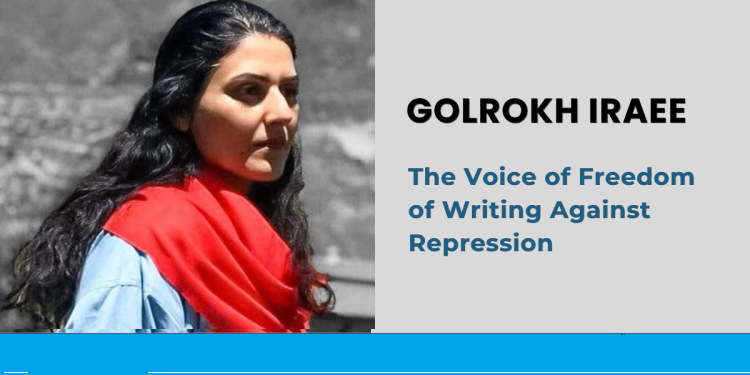
Golrokh Iraee, a prominent human rights activist and prisoner of conscience in Iran, has spent years behind bars because of her writings and advocacy for human rights, women’s rights, and freedom of expression. Born in 1980 in Amol, she has been repeatedly arrested and prosecuted for criticizing repressive policies, opposing executions, and defending fundamental freedoms.
Her legal case dates back to 2014, when Iranian security authorities used an unpublished story she had written about stoning as grounds to charge her with offenses including “propaganda against the state.” Since then, Iraee has been transferred between different prisons and remains imprisoned in the women’s ward of Evin Prison.
In a recent letter addressed to PEN America, Iraee reflects on the realities of censorship and repression in Iran, describing a society where speaking about poverty, inequality, state violence, and human suffering can lead to prosecution. She argues that writing remains both an act of resistance and a source of hope, helping to challenge silence and expose injustice.
Iraee describes the pen as “the cry of a shared suffering,” connecting the experiences of oppressed and marginalized people across borders. In her message, she recalls grieving mothers seeking justice, victims of violence, and children affected by war, emphasizing that the struggle for dignity and freedom transcends nationality, race, and gender.
Despite imprisonment and ongoing pressure, Iraee says she will continue to write and speak out. Concluding her message to PEN America, she stresses that freedom, justice, and equality can only be achieved through collective action, expressing hope for a future free from repression and discrimination.